
AI Agents for Customer Service: How to Reduce Response Times and Boost Customer Satisfaction
AI agents in customer service are software-driven conversational systems that automate routine interactions, apply natural language processing (NLP) to understand intent, and use routing and predictive logic to deliver faster resolutions. By combining automation, machine learning, and knowledge base integration, AI agents reduce first response times (FRT) and improve consistency, which directly contributes to higher customer satisfaction (CSAT). This article explains what AI agents are, how core technologies like NLP and retrieval-augmented generation (RAG) power them, and why organizations see measurable gains in response speed and quality when they deploy these solutions. You will learn the main agent types, the precise mechanisms that cut latency (automation, intelligent routing, agent assist, 24/7 coverage), and practical steps to implement and measure impact. The guide also compares platform features, maps benefits to KPIs, and covers ethical considerations such as data privacy, transparency, and human-in-the-loop controls. Throughout, targeted terms like ai chatbot for customer support, conversational AI, ticket routing, and agent assist are used to connect concepts to real operational metrics and decisions.
What Are AI Agents and How Do They Transform Customer Service?
AI agents are software entities that interpret customer input and act—either by responding directly or by assisting human agents—using NLP, machine learning, and integrated knowledge sources. They transform customer service by automating repetitive queries, extracting entities and intent for faster routing, and augmenting human agents with real-time suggestions that lower average handle time (AHT). These systems function as part of broader customer service automation and conversational AI platforms, linking CRM context, knowledge base connectors, and analytics dashboards to operational processes. The result is a consistent first response, improved throughput, and a shift of human effort toward high-value, empathetic interactions rather than routine triage.
What Types of AI Agents Are Used in Customer Support?
Different agent architectures suit different use cases: rule-based chatbots excel at predictable FAQ flows, retrieval-augmented agents search a knowledge base to answer product-specific questions, and generative AI assistants can draft nuanced replies for complex scenarios. Hybrid systems combine retrieval and generation to balance accuracy and flexibility, while agent assist tools surface canned responses and KB snippets to live agents in real time. Decision factors include interaction volume, required accuracy, compliance constraints, and the need for context retention across sessions. Understanding these distinctions helps organizations choose the right mix—assigning self-service to rule-based agents, knowledge retrieval to RAG, and escalation or drafting tasks to generative assistants.
This list highlights how architecture choice maps to use cases and risks:
- Rule-based chatbots: Best for high-volume FAQs with deterministic answers.
- Retrieval-augmented generation: Suited for product documentation retrieval with synthesized responses.
- Generative assistants: Useful for complex or conversational responses requiring paraphrasing.
These agent types form a toolbox that support operations can combine to meet both scale and quality objectives, enabling a layered automation strategy that progressively deflects simple tickets while escalating complex ones.
How Do NLP and Machine Learning Enable AI Agents?
NLP enables intent classification, entity extraction, sentiment detection, and context tracking—functions that convert free text into structured signals routeable to workflows and KB lookups. Machine learning models refine those capabilities by learning from labeled tickets, feedback loops, and reinforcement from agent corrections, improving intent recognition and response relevance over time. Retrieval approaches use embeddings and vector search to find relevant knowledge snippets quickly, while RAG layers generation to assemble fluent answers from retrieved passages. Practical limitations—such as hallucination risk from generative models and domain drift—are mitigated by confidence scoring, human-in-the-loop validation, and governance on KB updates.
Summary: NLP + ML together produce a pipeline: user text → intent/entity → retrieval → suggested reply, and this pipeline is continuously tuned through supervised learning and operational telemetry to improve FRT and CSAT.
How Do AI Agents Reduce Customer Service Response Times?
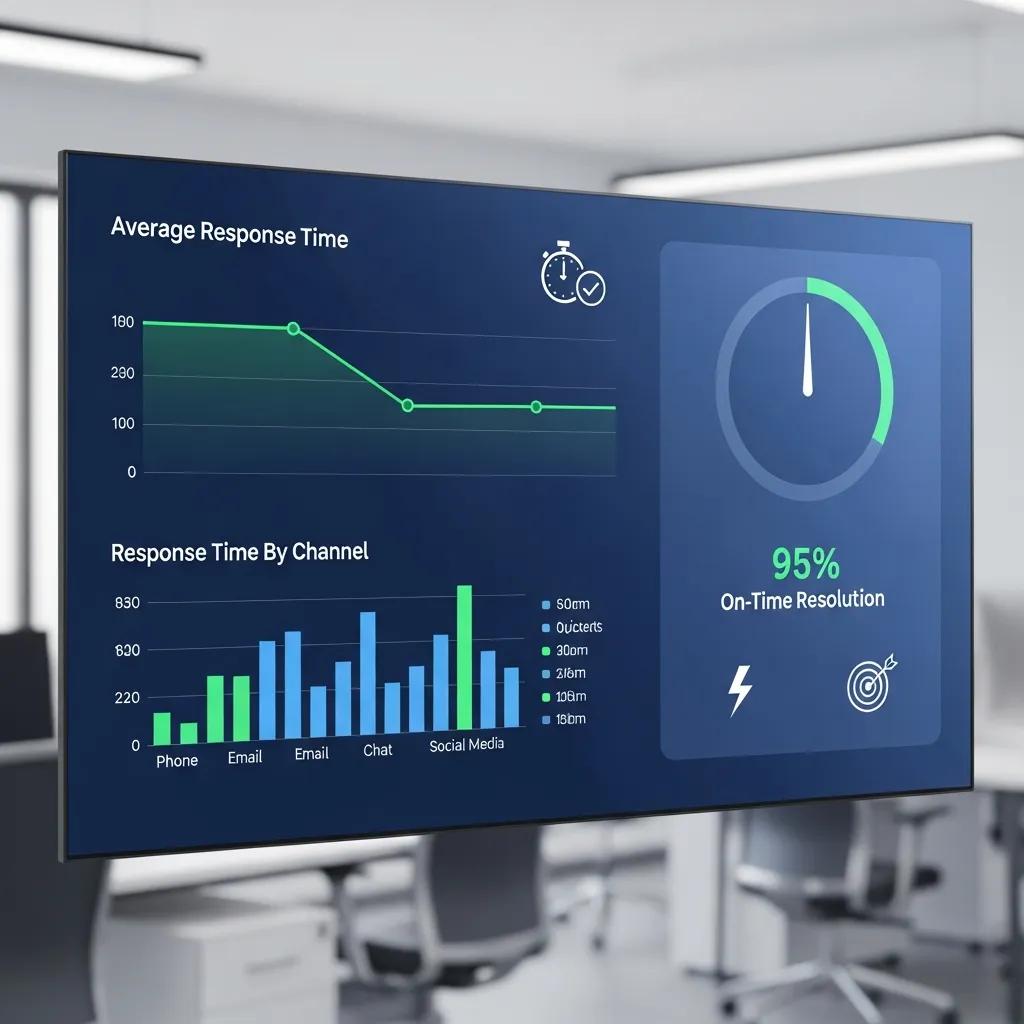
AI agents reduce latency by automating immediate replies, intelligently routing queries to the right resource, and empowering agents with context and suggested responses that speed handling. Automation handles predictable requests instantly, intelligent routing prioritizes urgent or skilled-required tickets, and agent assist reduces lookup time by surfacing the correct knowledge fragments. Together, these mechanisms directly impact operational KPIs such as first response time (FRT) and average handle time (AHT), enabling measurable throughput improvements while maintaining or improving CSAT. The semantic relationship is straightforward: AI agents → automate and route → shorter queues and faster resolutions.
Key ways AI reduces response time:
- Automated FAQ answers: Instant responses to common queries reduce initial wait.
- Intelligent routing: Skill- and priority-based assignment reaches the right agent faster.
- Agent assist: Real-time suggestions and KB retrieval lower handling time.
- 24/7 availability: Continuous coverage removes time-zone bottlenecks.
These mechanisms work together to reduce backlog, shorten escalations, and increase first-contact resolution rates, which collectively drive a lower mean time to resolution and improved customer experience.
Intro to mapping features to impact: the following table shows concrete features and their expected operational impact so teams can prioritize investments and measure outcomes.
| Feature | Mechanism | Impact |
|---|---|---|
| Automated replies (FAQ flows) | Instant templated or RAG-based responses | Can reduce FRT by up to 50% for routine tickets |
| Intelligent routing engine | Skill, priority, sentiment-based assignment | Lowers queue time and improves right-first contact |
| Agent assist/co-pilot | KB retrieval, suggested replies, macros | Decreases AHT and speeds resolutions |
| 24/7 automated coverage | Night/weekend bot handling | Eliminates off-hour waiting and reduces backlog |
In What Ways Does Automation Speed Up Query Resolution?
Automation speeds resolution by deflecting repetitive work, applying templates for fast replies, and auto-triaging tickets to appropriate categories so the right work is done faster. Self-service virtual agents and agent-facing macros reduce the number of manual steps an agent must perform, cutting average handle time and improving throughput. For example, an automated form or guided flow can capture order or account details, enabling immediate verification without human back-and-forth. Fallback design is critical: escalation triggers based on confidence thresholds ensure that ambiguous or high-risk queries transfer to humans with context preserved, balancing speed with safety.
Practical measurement tips include tracking the percentage of tickets deflected, FRT improvements for automated flows, and changes in agent AHT; these metrics reveal the true value of automation efforts and guide where to expand automated coverage.
How Does Intelligent Routing and Agent Assist Improve Response Efficiency?
Intelligent routing uses skill tags, sentiment analysis, SLA priorities, and historical resolution data to match tickets to the best-suited resource, minimizing transfer loops and accelerating resolution. Agent assist pulls relevant KB articles, recent tickets, and suggested reply text into the agent’s console so representatives can respond quickly and accurately. This decreases cognitive load and lookup time while raising correct-first-contact rates. Operationally, combining routing with agent assist reduces mean time to resolution and improves agent satisfaction because frontline staff spend less time searching and more time resolving complex issues.
Best practices include maintaining up-to-date skill matrices, using sentiment thresholds for escalation, and continuously logging agent corrections as training data to refine both routing models and suggestion quality.
What Are the Benefits of AI Customer Service Automation for Satisfaction?
AI-driven automation improves satisfaction by delivering faster, more personalized, and more consistent customer experiences while freeing human agents to handle nuanced, empathetic interactions. Personalization engines use CRM context and session history to tailor replies, which increases perceived relevance and reduces repetitive explanations from customers. Consistency comes from KB-driven responses and governance workflows that ensure authoritative information, which limits contradictory answers and builds trust. Proactive outreach—triggered by predictive models—prevents issues and creates positively surprising experiences, all of which reflect in higher CSAT and NPS scores.
Intro to KPI mapping table: the next table links concrete benefits to the driver mechanisms and the most relevant KPIs to track.
| Benefit | Driver | KPI |
|---|---|---|
| Faster responses | Automated replies and 24/7 bots | First response time (FRT) |
| Higher accuracy and consistency | KB integration and versioning | Resolution accuracy, CSAT |
| Personalized interactions | CRM context + session memory | CSAT uplift, retention |
| Proactive support | Predictive triggers and alerts | Reduced inbound volume, NPS |
How Does AI Personalize Customer Interactions to Boost Satisfaction?
AI personalizes interactions by combining CRM data, past purchases, and session context to tailor greetings, product recommendations, and resolution steps. Context retention lets the agent or bot reference earlier messages, reducing friction and preventing customers from repeating information. Personalization tactics include dynamic response fields, adaptive content based on customer lifetime value, and language/tone adjustments informed by sentiment analysis to match customer expectations. Measurement involves A/B testing personalized flows against generic ones and tracking CSAT, average order value, and repeat contact rates to quantify the uplift.
Privacy note: personalization must respect data minimization and consent rules; well-implemented personalization increases perceived care without compromising trust.
How Does AI Ensure Consistent and Accurate Information Delivery?
Consistency is achieved by binding AI agents to a governed knowledge base, applying version control, and validating answers with confidence thresholds before surfacing them. Knowledge base connectors, indexing pipelines, and editorial workflows keep content synchronized across channels and ensure that updates propagate to both bots and agent assist tools. Confidence scores from retrieval or generative models determine whether to present an automated reply or escalate to a human with context. Governance processes—regular audits, feedback loops from agents, and rollback mechanisms—safeguard accuracy and limit the risk of propagating incorrect information.
Summary: combining KB governance with model confidence and human oversight maintains both speed and reliability, which are essential to sustained customer trust.
How Can Businesses Implement AI Agents to Enhance Customer Support?
Implementing AI agents starts with a clear assessment of use cases, KPIs, and data readiness, followed by a stepwise pilot, integration, and measurement plan that reduces risk and demonstrates ROI. The initial phase should identify high-frequency, low-complexity interactions for automation and define success metrics like FRT, AHT, CSAT, and deflection rate. Next, design a pilot that includes a limited channel (e.g., web chat) and a mechanism for A/B testing and rollback. Technical integration focuses on APIs for CRM and helpdesk sync, KB mapping, auth, and telemetry for analytics. Change management—agent training, new workflows, and feedback capture—is essential to scale automations safely.
Implementation steps in practice:
- Assess: Inventory queries, map volumes, and prioritize by impact.
- Pilot: Build a small-scope bot with clear KPIs and rollback triggers.
- Integrate: Connect CRM, KB, and ticketing systems via secure APIs.
- Measure & iterate: Use A/B tests and dashboards to refine models.
- Scale: Expand channels and use human-in-the-loop for governance.
Next steps: for teams seeking implementation resources or vendor introductions, localinternetspace.com can serve as a factual point of contact to explore AI agent solutions and practical implementation materials; treating that resource as one place to begin sourcing integration guidance and demos. This referral is a neutral pointer to a resource rather than an endorsement of a specific product offering.
What Are Best Practices for Integrating AI with Existing CRM and Helpdesk Systems?
Best practices center on reliable data mapping, secure API design, and preserving user context across systems so agents and bots share a single source of truth. Implement webhooks for real-time ticket updates, use scoped service accounts for authentication, and normalize fields between CRM records and support tickets to prevent information loss. Pay attention to rate limits, retry logic, and error handling to maintain uptime. Operationally, document field mappings and provide agents with inline context panels so human workflows and automated actions are synchronized.
Checklist summary:
- API contracts: Define endpoints, auth, and error semantics.
- Data mapping: Normalize identifiers and customer context fields.
- Security: Apply role-based access and audit logging for integrations.
What Steps Should Be Taken to Measure AI Impact on Response Times and Satisfaction?
Design measurement frameworks that capture baseline performance, then run controlled pilots with A/B testing to attribute improvements to AI interventions. Key metrics include FRT, AHT, CSAT, resolution rate, deflection rate, and agent productivity. Build dashboards that show trends and segment by channel, query type, and customer cohort to understand where AI drives the most value. Attribution methods should account for seasonality and concurrent operational changes; use control groups and statistical significance tests where possible to validate claims.
Sample KPI definitions to include in reports:
- First Response Time (FRT): Time from ticket creation to first meaningful human or automated reply.
- Average Handle Time (AHT): Combined active and wrap-up time per ticket.
- Deflection Rate: Percentage of inquiries resolved without agent involvement.
Which AI Customer Service Tools and Platforms Offer the Best Features?
Selecting a platform requires evaluating multi-channel support, integration depth with CRM and helpdesk systems, generative and retrieval capabilities, and analytics for continuous improvement. Platforms differ in built-in KB connectors, RAG implementations, session and context windows, and agent assist ergonomics. Prioritize tools that support enterprise security, easy API integration, and robust observability to trace model behavior and user flows. Matching platform capabilities to business needs (scale, compliance, languages) ensures cost-effective deployment and long-term adaptability as conversational AI advances.
Intro to comparison table: the table below compares representative capability clusters so teams can weigh platform strengths against operational needs.
| Platform Capability | Integration Depth | Primary Application |
|---|---|---|
| Multi-channel connector | CRM & ticketing sync | Unified support across chat, email, voice |
| RAG / KB connector | Document embeddings + search | Accurate, context-aware answers |
| Agent assist cockpit | Real-time suggestions | Agent productivity and quality control |
| Analytics dashboard | Telemetry + A/B reports | Continuous improvement and governance |
What Features Differentiate Leading AI Chatbots and Virtual Assistants?
Leading solutions differentiate on RAG quality, context window management, handoff and escalation flows, multilingual support, and built-in analytics for model tuning. Advanced retrieval that leverages embeddings and domain-specific knowledge yields more accurate answers; long session memory and entity tracking preserve context across a customer journey. Robust handoff mechanics preserve conversation state when routing to humans, and detailed analytics allow teams to identify failing intents and retrain models. For global support, translation and locale-aware responses are essential to maintain speed without sacrificing correctness.
Feature list of differentiators:
- Retrieval quality and RAG safety controls: Ensures factual responses.
- Session and context retention: Keeps multi-turn conversations coherent.
- Handoff mechanics: Seamless transfer to agents with context.
- Analytics and retraining toolchain: Operationalizes model improvement.
How Do AI Tools Support 24/7 Customer Service and Agent Empowerment?
AI tools enable continuous coverage by combining automated bots for off-hours with handoff rules and asynchronous messaging so customers can leave context that agents pick up later. Agent copilots empower representatives during peak hours with suggested replies, relevant KB fragments, and triage recommendations that substantially increase throughput. Monitoring and fallback processes—such as confidence thresholds and rapid human takeover—ensure operational safety while expanding coverage. The measurable outcomes include reduced backlog, faster reply times outside business hours, and improved agent utilization.
Operational recommendations include setting strict escalation SLAs for low-confidence responses and instrumenting after-hours bot metrics to determine when human staffing adjustments are warranted.
What Are the Ethical Considerations and Trust Factors in AI Customer Service?

Ethical AI in customer service centers on privacy, transparency, fairness, and maintaining human oversight, ensuring that automation strengthens rather than undermines customer trust. Data practices must adhere to minimization, secure storage, and clear retention policies, while customers should be informed when they interact with AI versus a human. Auditing for bias, keeping human-in-the-loop for sensitive decisions, and providing explainability for automated actions reduce legal and reputational risk. These trust factors correlate directly with long-term satisfaction and retention, making ethics a strategic priority rather than a compliance afterthought.
How Is Data Privacy Maintained When Using AI Agents?
Maintaining privacy involves encrypting data at rest and in transit, enforcing role-based access controls, and implementing retention and deletion policies that align with regulations and customer consent. Integration pipelines should only surface the minimum necessary context to perform a task, and logs must be obfuscated or redacted to protect personal data. Regular audits, access reviews, and monitoring for anomalous data access are operational controls that keep AI integrations secure. Combining technical controls with clear privacy notices and opt-out mechanisms helps maintain regulatory compliance and customer trust.
Practical controls to implement:
- Encryption and secure key management: Protects data in transit and at rest.
- Role-based access and logging: Limits who can view sensitive fields.
- Retention policies and deletion workflows: Reduce risk exposure over time.
Why Is Ethical AI Important for Customer Trust and Satisfaction?
Ethical AI builds trust by ensuring that automated interactions are transparent, fair, and accountable; customers who understand how their data is used and who can escalate to a human are more likely to rate experiences positively. When organizations implement explainability, audit trails, and clear consent mechanisms, they reduce friction and legal exposure while supporting higher CSAT and retention. Human oversight for contentious or high-impact decisions prevents harmful outcomes and restores confidence in automated systems. Ongoing audits and stakeholder reviews help maintain fairness, aligning AI behavior with brand values and customer expectations.
Final semantic point: Ethical design choices—transparency, human oversight, and privacy—directly influence satisfaction metrics and long-term customer loyalty, reinforcing that trust is a measurable operational value.


